Boston cream pie: History, Origin, Ingredients, Recipes
Boston cream pie: History, Origin, Ingredients, Recipes
“Boston cream pie is Massachusetts’ sweet deception—not a pie at all, but a cake that captured the hearts of a nation.”
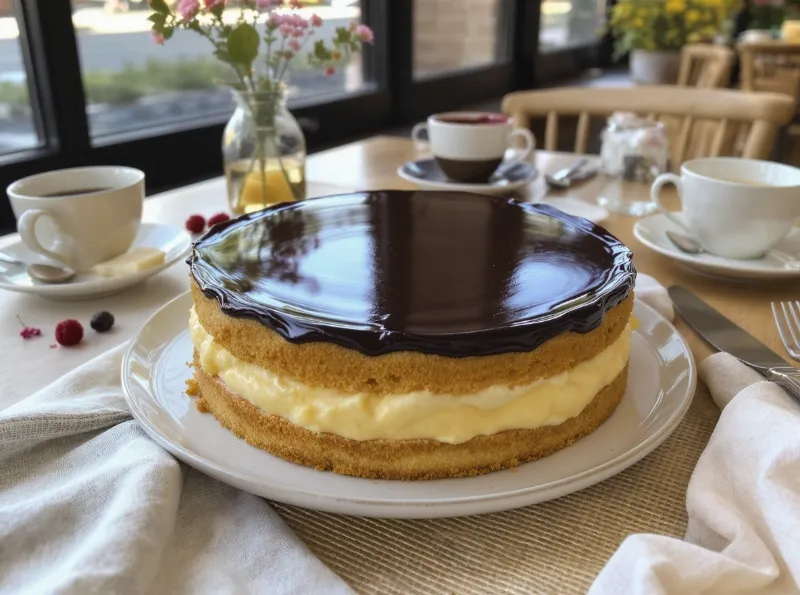
Boston cream pie is a classic American dessert consisting of two layers of sponge cake filled with vanilla custard or crème pâtissière and topped with chocolate glaze. Despite its name, this beloved creation is definitively a cake, not a pie—a naming quirk that reflects 19th-century American culinary terminology when cakes and pies were often baked in similar tins and the terms were used somewhat interchangeably.
Created at Boston’s Parker House Hotel in 1856, this dessert became so iconic that the Massachusetts legislature designated it the official state dessert in 1996. Boston cream pie represents a pivotal moment in American baking history, when French culinary techniques were adapted and Americanized, creating a distinctly new dessert that would influence countless variations and become a permanent fixture in American bakeries, donut shops, and celebrations.
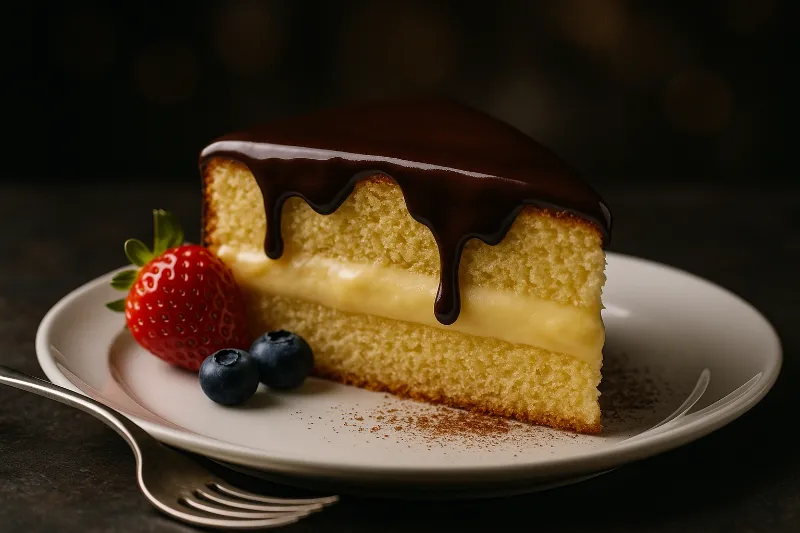
[Image: A slice of Boston cream pie showing yellow cake layers, vanilla custard filling, and chocolate glaze topping]
Table of Contents
Historical Origins and the Parker House Legacy
Boston cream pie was created in 1856 by Armenian-French chef M. Sanzian at the Parker House Hotel in Boston, Massachusetts. The Parker House, opened in 1855, quickly became one of America’s most prestigious hotels, hosting luminaries including Charles Dickens, Ralph Waldo Emerson, and John F. Kennedy. Chef Sanzian developed the dessert as an elegant offering for the hotel’s sophisticated clientele, drawing on French pastry traditions while adapting them for American tastes and ingredients.
The original “Parker House chocolate cream pie,” as it was initially known, featured two layers of French butter sponge cake (génoise) filled with vanilla custard and topped with chocolate fondant. The dessert was revolutionary for its time, introducing hotel guests to refined French pastry techniques in a format that felt familiar yet special. The term “pie” was used because cakes and pies were often baked in similar round pans during this era, and the distinction between them was less rigid than today.
The dessert gained immediate popularity and began appearing in cookbooks and bakeries throughout New England by the 1860s and 1870s. Its appeal lay in its perfect balance of textures and flavors—light, tender cake providing structure for rich custard, all complemented by the slight bitterness of chocolate. As it spread across America, the recipe evolved slightly, with some versions using different cake bases or chocolate toppings, but the essential character remained constant.
Boston cream pie achieved official recognition in 1996 when Massachusetts designated it the state dessert, beating out other contenders including Indian pudding and Toll House cookies. This designation acknowledged the dessert’s historical significance and its role in establishing Boston as a culinary destination. Today, the Parker House Hotel (now the Omni Parker House) continues to serve the original dessert, maintaining a direct link to its 19th-century origins.
Components and Construction
Boston cream pie consists of three essential elements, each requiring careful preparation for optimal results. The cake base is traditionally a yellow butter cake or génoise—a light, airy French sponge cake made with eggs, sugar, flour, and melted butter. The cake must be tender and moist enough to complement the custard without becoming soggy, yet structured enough to support the filling. Most modern versions use a simplified butter cake rather than traditional génoise, which requires more technique to execute properly.
The cake is baked in two round layers, typically 8 or 9 inches in diameter, or as a single thick layer that’s split horizontally after baking. The layers must be completely cool before assembly to prevent the custard from melting. Some bakers brush the layers with simple syrup to add moisture and help them stay fresh longer, though this is optional.
The filling is vanilla custard, also called crème pâtissière or pastry cream, made from milk, egg yolks, sugar, cornstarch, butter, and vanilla. This is a cooked custard that must be thick enough to stay in place between the cake layers without oozing out, yet smooth and creamy rather than gluey. The quality of vanilla used dramatically impacts the final flavor—pure vanilla extract or vanilla bean paste provides the characteristic flavor that defines authentic Boston cream pie. The custard must be completely cool before assembly, as warm custard will melt into the cake.
The chocolate topping is traditionally a poured chocolate glaze made from chocolate, heavy cream, butter, and sometimes corn syrup for shine. This creates a smooth, glossy coating that sets to a semi-firm consistency, remaining slightly soft. The glaze should be pourable but thick enough to coat evenly without running off excessively. Some versions use chocolate ganache, which provides similar results with a richer chocolate flavor.
Assembly and Presentation Techniques
Proper assembly is crucial for creating an attractive, well-proportioned Boston cream pie. The process begins with preparing a completely cooled first cake layer on a serving plate or cake board. If using simple syrup for moisture, it’s brushed on at this point. A generous amount of cooled custard—typically 1 to 1.5 cups—is spread evenly over the first layer, leaving about a half-inch border around the edge to prevent excessive squeezing out when the top layer is added.
The second cake layer is carefully positioned on top of the custard, pressed gently but firmly to create even contact. Any custard that squeezes out is gently scraped away with a spatula. At this point, many bakers chill the assembled cake for 30 minutes to allow the custard to set and firm up, making chocolate glazing easier and preventing the layers from sliding.
The chocolate glaze is prepared by heating heavy cream until steaming, then pouring it over chopped chocolate and letting it sit for a minute before stirring until smooth. Butter is stirred in for added shine and smooth texture. The glaze should be warm but not hot—around 90-100°F (32-38°C)—for optimal pouring consistency. It’s poured onto the center of the cake’s top layer and spread with an offset spatula or allowed to flow naturally toward the edges, where it can drip down the sides for a classic look.
The glazed cake is chilled for at least 30 minutes to set the chocolate before slicing. When serving, use a sharp knife dipped in hot water and wiped clean between cuts to achieve neat slices that showcase the distinct layers of cake, custard, and chocolate.
Variations and Adaptations
While purists insist on the traditional version, numerous variations have emerged over Boston cream pie’s long history. Boston cream cupcakes transform the concept into individual servings, with vanilla cupcakes filled with custard and topped with chocolate glaze—a format popularized by national bakery chains and home bakers seeking portioned desserts.
Boston cream donuts, perhaps the most ubiquitous variation, feature yeasted donuts filled with vanilla custard and topped with chocolate glaze. This format was popularized by Dunkin’ Donuts and has become a standard offering in donut shops worldwide, introducing the Boston cream flavor profile to millions who might never encounter the original cake.
French-inspired variations use traditional génoise instead of butter cake, creating a lighter, more delicate texture closer to the original 1856 version. Some upscale bakeries create miniature versions in tart form, with individual pastry shells filled with custard and glazed with chocolate.
Modern creative adaptations include Boston cream poke cake, where custard is poured into holes poked in a sheet cake, then topped with chocolate; Boston cream layer bars with graham cracker crust, custard layer, and chocolate top; and even Boston cream macarons with vanilla custard filling and chocolate shells. Seasonal versions might incorporate pumpkin into the cake for fall, or add orange zest to the custard for brightness. Despite these innovations, the classic three-element format remains the standard by which all variations are judged.
Cultural Impact and Regional Pride
Boston cream pie occupies a unique position in American culinary culture as both a historical artifact and a living dessert tradition. Its creation at the Parker House Hotel coincided with Boston’s golden age as America’s intellectual and cultural capital, and the dessert became associated with the city’s sophistication and refinement. For Bostonians, the dessert represents civic pride and culinary heritage, embodying the city’s role in American gastronomic history.
The dessert’s influence extends far beyond Boston. It established the flavor combination of vanilla and chocolate as a American classic, appearing in countless other desserts. The Boston cream donut alone has introduced millions of people worldwide to this flavor profile, making it one of America’s most recognizable dessert exports. The dessert also represents the Americanization of French culinary techniques—taking refined European methods and adapting them into something new and distinctly American.
Boston cream pie appears frequently in American popular culture, from references in television shows and movies to special promotions by bakeries on Boston-related holidays. Its status as Massachusetts’ official state dessert ensures it remains relevant in discussions of American regional foods and culinary identity.
Storage and Serving Considerations
Due to its custard filling, Boston cream pie requires refrigeration and should be consumed within 2-3 days for best quality and safety. The assembled cake should be stored in the refrigerator, covered with a cake dome or loosely with plastic wrap to protect it without damaging the chocolate glaze. Allow the cake to sit at room temperature for 15-20 minutes before serving to take the chill off and allow flavors to come forward.
For make-ahead preparation, components can be prepared separately: cake layers can be baked, cooled, wrapped, and stored at room temperature for up to two days or frozen for up to one month; custard can be made a day in advance and refrigerated. However, once assembled and glazed, the cake should be served within 24 hours for optimal texture, as the custard can make the cake layers soggy over time.
Conclusion
Boston cream pie stands as one of America’s most significant culinary creations, bridging French sophistication and American practicality into a dessert that has endured for over 165 years. From its origins in an elegant Boston hotel to its current status as a state symbol and donut shop staple, this “pie” that isn’t actually a pie represents American innovation and adaptation at its finest. Its perfect balance of light cake, smooth custard, and rich chocolate continues to delight dessert lovers across generations, ensuring that Chef Sanzian’s 1856 creation remains as relevant and beloved today as it was in Victorian-era Boston.


